VERSION # 1.00
Last Updated 3:37 PM 2/20/2019
Write down EACH of the permutations of formlae and such that are related to electric potential (AKA electric potential difference, potential difference, ∆V, change in voltage)
════════════════════
ANSWER: (No Peeking!)
- Vb - Va = ∆V
- ∆U=q∆V
- W = q∆V = -UE
- V = ke∑qi/ri (between some point in space and each charged particle present in that region of space)
- V = ∫kedq/r
YIIIKKEEEESSSSS... but Mr W, my brain is gonna implode!
Mine too.... flash cards, quizzing your comrades etc etc... gotta do it!
Let's take a gander at example 25.1 (that's pretty straight forward)
Now let's take a looksee at example 25.2
On the few days that we actually had class (so to speak!) there was some question about what the heck a *Uniform* electric field might be.
Our impression was that "uniform" means that the electric field has the same value at each point on the efield line:
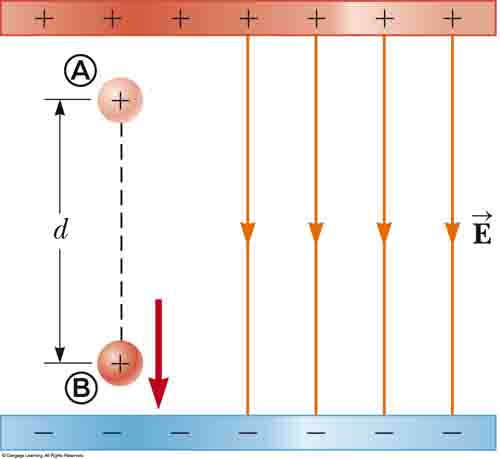
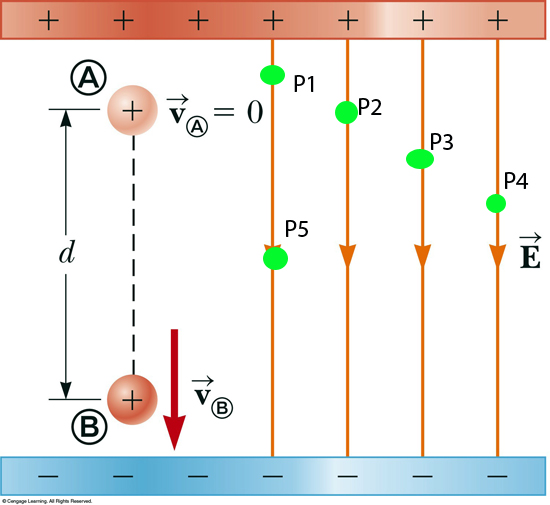
It turns out that if we have two charged plates with equal but opposite charged surfaces, that the efield lines between them are, to a fairly high degree, uniform (if you are curious, check out example 23.9 and especially the bottom of example 24.5 to see that the Efield between two equally charged plates is σ/εo. Notice the Efield is position independent.
That means a trusty dusty test particle dropped in to our Uniform Efield at various points shown will experience the same electric field.
See example 25.1... that is a bit more predictable.
If your brain still hurts then just keep in mind that there IS such a thing as a Uniform electric field between two equally charged plates.
════════════════════
Ok... enough of that... let's see if we can tie in a bunch of what we've talked about so far.
Problem 25.19 is helpful here... Do That!